
How it works
This page explains what happens from the moment you submit, how long each stage takes, and what a decision can and cannot do.
If you want the legal version, our Rules of Procedure sets this out in full.
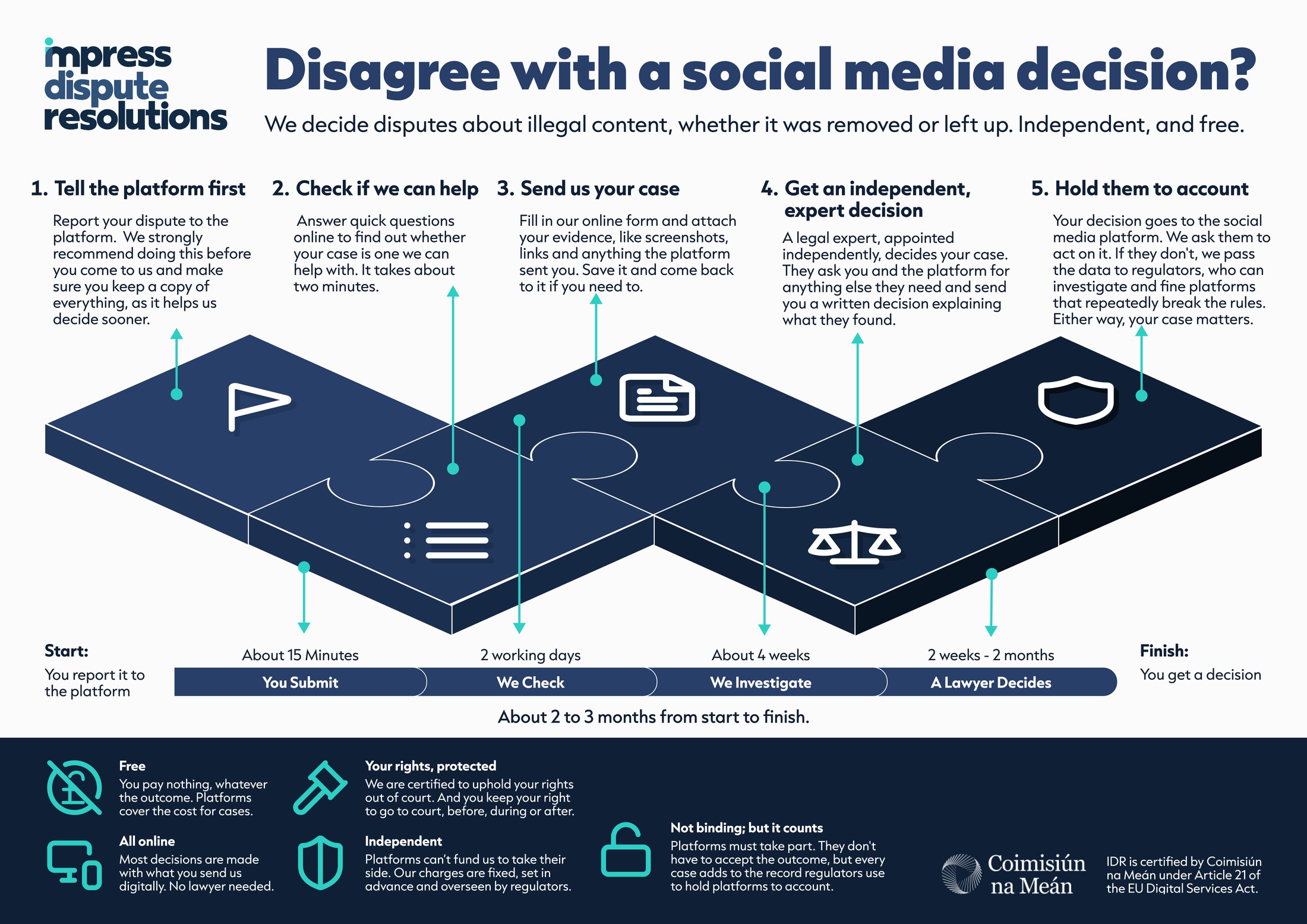
Prefer to read it as text? The full written version is below.
Work with people affected by content online? Share this guide with them.

What to have ready

Your case will get decided faster with this information. Without it, we may not be able to make a decision. You do not need a lawyer, and you do not need to get this perfect.
- Links to the content you are complaining about, if it is still online
- Screenshots, as evidence
- The reference number the platform gave you when you reported it, and any decision they sent you
- The date you reported it to the platform
- A short description of what happened and why you think the platform got it wrong
- Anything else supporting your case, such as account details, correspondence or documents
We strongly recommend reporting the content to the platform and waiting for their decision before you come to us. Your case decision maker is reviewing that decision, so without it there is much less for them to work with.
If you are missing something, submit anyway. We will tell you what else we need.
The three stages
The guide above shows the journey from your side, including the steps you take before you reach us. Below is what happens once your case is with us. We will tell you when you move from one stage to the next.
Stage one
We check your case
Stage two
An independent expert decides your case
Stage three
You get a decision

Stage one: we check your case
When your submission reaches us, a case administrator checks that we have everything we need and that your case is one we can take.
If something is missing, we will contact you quickly to ask for it and give you a deadline to send it.
We aim to tell you within two working days whether we can accept your case. If we cannot, we will write to you and explain why.
Once we accept your case, both you and the platform sign an agreement covering how the process will run. We then ask Ciarb to appoint a case decision-maker, who will decide your case under our rules.

Stage two: an independent expert decides your case
Ciarb appoints a case decision-maker from our panel. We have no part in choosing who that is.
Everyone on our panel is a qualified lawyer with at least seven years’ post-qualification experience and arbitration accreditation from Ciarb.
Ciarb assesses every candidate and checks their outside interests before appointment.
The first thing they do is check the case for themselves. This is a second look at whether your case can proceed, separate from the check we did. If they decide it cannot, both you and the platform get the chance to argue otherwise before the case closes.
Once your case is confirmed, your case decision-maker takes charge of it and issues a formal notice that the case has begun. From that point, they decide how it is run and what evidence is needed, working within the Rules of our Scheme.
We run the process around them. We manage your case from start to finish, keep both sides to the timetable, handle everything that passes between you, and make sure the scheme operates as it should. Your case decision-maker decides the case. We are responsible for everything else.
They will usually ask you to expand on what you first told us, or to correct anything, and to send any documents you want them to consider, by a set date.
They will ask the platform the same: to expand on what it has said, and to provide its documents by a set date.
You will not need to attend a hearing in most cases. If your case does need one, your case decision-maker will explain what that involves.

Stage three: you get a decision
Your case decision-maker issues a preliminary decision first, setting out what they have found and why. Both you and the platform receive it at the same time.
You then get a chance to comment on it, or to ask for something to be changed. If you ask for a change, your case decision-maker decides whether to make it. Either way, they tell you what they have decided and why.
Once that window closes, the decision is final and the case ends. We do not look at the same issues again and once closed there is no right of appeal.

How long it takes
Most cases take around one to three months from the day you submit to the day you get a decision. Simple cases are quicker. Cases needing more evidence, or a hearing, take longer.
Two things are fixed, whatever happens to your case:
| Type of case | Fixed limit |
|---|---|
| A case decided without a hearing | Concludes within three months of your case decision-maker being appointed |
| A case needing a hearing | Concludes within six months of appointment |
Only the most complex cases fall outside this, and you will be told if yours is one of them.
The illustration at the top of this page shows roughly how long each step takes. If your case is taking longer than expected, tell us and we will explain where it is.
What we need from you, and by when
The process has deadlines on your side too. We will always remind you before it passes.
If something is missing from your submission, we will ask for it and give you a deadline. We remind you twice before it expires.
If your case decision-maker issues a preliminary decision, you have 7 working days to comment on it or ask for a change.
If you need more time at any point, please let us know.
If we cannot reach you at all, we will close the case. That does not count against you, and you can bring the same complaint again later.
What a decision can say
Your case decision-maker sets out what they have found and what, if anything, should happen next. That can include the following.
A finding on the platform’s decision
This is the main thing you are asking for. The decision sets out whether the platform’s decision was right, and why.
A direction to the platform to put something right
Where your case decision-maker finds the platform got it wrong, they can direct the platform to act. What that looks like depends on what happened.
If the platform left content up
- Remove the content
- Restrict who can see it
- Add a label or warning to it
If the platform took your content down
- Put your content back up
- Reinstate your account
- Remove a restriction on who can see your posts
- Remove a label applied to your content
- Restore monetisation
Your case decision-maker is not limited to a list of fixed remedies. If your case needs something else, they can direct it.
A direction to publish a summary
The case decision-maker can direct that a summary of the decision is published, in a form both sides agree.
Compensation, in rare cases
Where you can show you have suffered financial harm, the case decision-maker can advise that you are owed compensation, up to a maximum of 25,000 Euro. Note this is at platform discretion, and seeking payment will likely require legal recourse.
This finding requires evidence of actual financial loss and is reserved for exceptional cases. Most decisions do not involve any monetary recommendations. Our process is not a route to compensation, and you should not bring a case expecting one.

What a decision cannot do
Our decisions are not legally binding, so neither you nor the platform is legally required to follow one.
Platforms are legally required to engage with our process. They are not legally required to act on the outcome. Where a platform does not act on a decision, we record it, and it appears in our public reporting and is shared with the regulators who can hold platforms to account. Your case is never wasted.
Bringing a case to us does not affect your right to take it to court, before, during or afterwards.

When a case can be stopped early
Most cases run to a decision. Occasionally a case decision-maker will end one early, either because a party has not done what was asked of them, or because of a problem with the claim itself.
If either side ignores a direction, the case decision-maker can decide the case on the evidence they already have or end it altogether.
A claim can also be stopped where:
- there is no reasonable basis for bringing it
- it was brought in bad faith, or is an abuse of the process
- the issue is so minor that the time and cost of the process would be out of all proportion to it
- new parts of the claim are raised after the deadline, without a good reason for the delay. In that case, only those parts are affected
- the case can only properly be resolved by a court or is much better suited to one. This happens where a case turns on a difficult point of law
If your case is stopped, you will be told why in writing.
What happens next
Once the decision is final, we write to the platform and ask what it has done about it. We record their answer, whether they accepted the decision, refused it, or proposed something else. If they do not respond at all, we record that too.
That record goes into our public reporting, whichever way it goes, and it forms part of what we report to Coimisiún na Meán. Regulators can investigate and fine platforms that repeatedly break the rules. Your case is part of that picture whether or not the platform acts on it.
When we close your case, we will send you a summary of what was decided, what remedy was directed if any, how long we keep your information and when we delete it, and the anonymised summary of your case that we intend to publish.
If you are unhappy with the way we handled your case, you can ask for our service to be reviewed independently once the case has closed. Note this is distinct from the decision itself, meaning it reviews our process but is unlikely to alter your decision. A dedicated form is in development. Until it is live, please email your complaint to help@impressdisputeresolutions.org, quoting your case reference number.

Staying in touch with us
We will contact you at each stage, so you will not need to chase us for updates.
If you want to add something before we have contacted you
Email disputes@impressdisputeresolutions.org with your case reference number.
If your case decision-maker has been appointed
Send anything further to us and we will pass it on. Please do not contact the case decision-maker directly. They have to be able to show that both sides are treated the same, and that includes how information reaches them.
If your contact details change
Tell us straight away. If we cannot reach you, we may close your case.

The full rules
Everything on this page is a summary. Our Rules of Procedure set out the complete process, including the admissibility criteria, the powers of the case decision-maker, and how evidence is handled.
You do not need to read them to bring a case. They are there so that you can, and so that anyone can check how we operate.
Ready to start?
It is free, and you can save your progress at any point.